From Fastnachts to Truth-telling; Ash Wednesday reflections

Today as I write it is Ash Wednesday.  And during the years I lived in Harrisburg, Pennsylvania, of course every Ash Wednesday followed Fastnacht Day, the annual Pennsylvania Dutch celebration on Shrove Tuesday.  Every year now I remember fondly that the day would begin bright and early with the delivery on our porch of a small paper bag filled with 6 or 7 Fastnachts still warm and ready to eat.  If you didn’t grow up in Central Pennsylvania and if you didn’t have a church member around like Hilda Gibbel, you probably weren’t blessed with the gift of Fastnachts on Fat Tuesday to get you ready for Ash Wednesday.  Fastnachts are deep fried doughnuts, fried in lard, with a dusting of crunchy sugar crystals, hopefully still warm from the bakery when you eat them.  Very yummy.  

That tradition was always a significant one for us mostly because of what a beloved great saint Hilda Gibbel was to our congregation.

But it was also a reminder that the season of Lent was about to begin, and we were encouraged to enjoy the sweets of Fat Tuesday in anticipation of giving up something during Lent. 

The denying of pleasures to our bodies could hopefully have its effect on our spirits for the better. 

Each Lent I have usually tried to think of something that would be significant enough to give up in order to be a daily reminder of the need for rigorous spiritual reflection and strengthened discipline in my spiritual life.   So, over the years, there have been the usual denials of sweets, of evening snacks, even reluctantly of chocolate.

The most difficult sacrifice I remember making was during college when my roommate Patti and I decided to give up complaining for Lent.  Now that was a rigorous discipline.  I’ll never try that again!

And then several years ago there began the regular invitation from Pope Francis to give up something different.  To give up inattention to the poor and to give our lives instead to others in compassionate living.  

This Lent my choices have been influenced by some ongoing virtual conversations I’m fortunate to be part of with several leaders from my denomination sitting together with several members of the LGBTQ+ community, envisioning what a more just and whole future might look like for the denomination.  What process might lead the church there, we’re wondering together?

In a recent conversation, the topic of reparations came up and with it the reminder that the first step in a process of reparations normally is the work of truth-telling.  Telling the story of what has happened, what has been the impact on those most vulnerable, what has been the lived experience of those most affected, those who have suffered violence and harm among us for decades and longer?

What if, I wonder, what if my Lenten practice were somehow connected this year with greater truth-telling, in my life and in my work? What might that look like as a daily discipline?  Or for a weekly challenge?

To that end, I have been looking for models of truth telling in the scriptures.  

Obviously, the gold standard is Jesus’ bold, costly, life-risking practice of truth telling. 

There is Esther faced with the need to tell the truth about her identity and save her people from destruction.  

There are the female disciples, the first ones to tell the truth of the resurrection even if their male hearers disbelieved them.

And then there is Judah.  Yes, Judah, the 4th-born one of the 12 tribes of Israel.  He is one who was faced with the need to speak truth several times in the Genesis narrative especially the Joseph story.  He is the story partner of Tamar in the fascinating narrative found in Genesis 38.  He is quite a study in the perils of truth telling, the challenges of cowardice and courage.  What might we learn from him, I wondered?

We could spend the next hour combing these fascinating stories for pearls of wisdom and challenge.  But you have other things to do today. So, suffice it to just mention a few points.

You may remember that Judah and his brothers grew sick and tired of their brother Joseph’s boasting of dreams and his grand self-importance.  So, they decided to kill him.  Reuben had convinced his brothers to just throw Joseph into a pit.   Judah then convinced them to sell Joseph to Midianite traders passing by.  Was that a show of courage to oppose his brothers or was it a cowardice that failed to protect Joseph?  He may have had good intentions “but in the end, intentions don’t matter, do they?   Impact does.”1

Later on, in the Joseph story, Judah intervenes twice to protect the youngest brother, Benjamin, from harm.  Judah promises himself as surety to his father to bring Benjamin back from their trip to Egypt.  And then Judah pleads with Joseph to keep him in place of Benjamin as the plot twists and turns.  Is this speaking up on his part a sign of courage or is it cowardice to admit the truth of the awful harm they had done to Joseph years ago?

Finally in the story of Judah and Tamar we see Judah’s true stripes revealed, as the saying goes.

When Judah sees that his first two sons die while married to Tamar, he refuses to give Tamar to his third and only remaining son as would be required by the levirate marriage law.  She is still bound to his family though and stuck in limbo without the option to break free.  Judah is afraid to risk.  He is a coward when the courage to risk was needed.

Tamar on the other hand takes a tremendous risk, setting aside proper behavior, personal security, her reputation, risking her own life in order to produce an heir for the family who will care for her and continue the family line.  Both needs were being ignored by the one who had the power to act in righteous ways.

When Judah is confronted by Tamar with the truth of his actions, the truth of his failure to act in just ways, he finally has the courage and humility to say one of the most extraordinary lines in all the Hebrew Bible.  He says in effect, “This woman who has played the harlot and exposed my cowardice and my refusal to risk, this woman is more righteous than I am.”

Because her life has exposed the truth of his cowardice in very visible and public ways, he speaks the truth that his life should have made visible.  She is more righteous than I.

Rabbi Danya Ruttenberg writes about this story, “In this moment, Judah sees how preventing this marriage harmed her, understands what he should have done instead, and admits that he was in the wrong.”2

Judah speaks a brave and unflattering truth about himself, a patriarch, and head of a family in the line of the 12 tribes of Israel.  He also speaks a powerful and honest truth that reflects how he has been changed by facing the truth of the harm he has caused to this heroine, this vulnerable, marginalized, gutsy, powerful, and scandalous widow.  

In this Lenten season, what truth do we want our lives to witness to?  

Could we set for ourselves the Lenten discipline to seize moments in which to speak and act with courage?  

When and to whom will you speak the truths that you need to share?  

Maybe we will speak the truth of another’s belovedness when that is being denied them. 

Maybe the truth of undeserved grace for someone.  

The truth of a generosity of spirit that lifts and empowers.   

Maybe we will speak a truth that emerges from a deep place of listening.  

The truth that names the harm that has been done and our part in it.  

A truth that insists on real repentance showing itself in personal and institutional change. 

The truth that sounds a lot like Jesus in new places in our neighborhoods and communities. 

A truth that invites others into wonder, into creativity, and even into play.  

Go ahead and fast this Lent if you’d like to, but let’s not miss the chance to feast as well.  Feast on truth-telling and truth-filled living in small ways and big ways and in whatever ways you can.

Gracious God, wherever your Spirit leads us in this Lenten season, 

may we travel boldly, mindful that we are your beloved children.

Help us to walk in truth that radiates brightly from within us.

Shine on the path before us with the light of your presence so that we may not lose our way.  And enable us to walk in faith together knowing that you go before us all the way.  Amen

1, 2 https://lifeisasacredtext.substack.com

Ode to my Morale Officer

We meet at the break of my day 

together at your water bowl, faithful feline.

There you sit like a wary sentinel 

watching me with guarded hope.

“Will my human remember me?  

Will she treasure my needs and soothe my thirsty tongue?  

Will she refresh my parched throat again one more day?”

I faithfully tend to our morning ritual, 

fearful as I am of your ruthless wrath

taken out on me in corners or edges of rooms 

with presents I fail to value as you do.

So, aware of the consequences of mindless forgetfulness,

I carefully rinse the small round bowl each day

Filling it with filtered water

Two ice cubes, and on a special occasion, three or even four.

The small cold rectangles clink and pop as they greet the tepid water.

Some mornings I walk away, perplexed, and alarmed at the 

ease with which you disregard my offering

electing instead to return to the couch for your day’s labor of slumber

while I continue with human rituals

Strong coffee, Dominican-style, obligatory dull oatmeal, 

gentle stretching, essential bathing and dressing, 

Precious crumbs of prayer while taking up the day’s work

All this as you while away the hours devising new tortures for

the mindless human who holds in human paws your very existence.

How often I lament the restrictions and limits

 your continued existence impose on my daily life and space

While forgetting the companionship, the comfort,

the faithfulness you have embodied

over these last 14 years,

wrenched from your native Santo Domingo

your small body cruelly stuffed under the seat 

during that plane ride of horror

Transported to the alien valley of Virginia,

 then on to rolling gentle hills of Ohio

Where to next, you wonder, with anxious trepidation?

Wherever we go, I suppose we must go together 

Friends, partners, love/hate adversaries, 

Companions forever, bound by love

Living Black and White/ Living Color

One of my distinct memories as a little girl includes watching television in black and white.  Among the shows that created my first memories of TV were the Dick Cavett show, the Dick Van Dyke show, I Love Lucy, I Dream of Jeannie, What’s my Line, and the Ed Sullivan show (yes, these date me as that old!).  All these memories are black and white in my mind.  We knew nothing else.  Color TV had not arrived on the scene at that time, at least not on our rural Pennsylvania farm scene.

When color TV presented itself in the mid-1960s, we eagerly made the switch.  It was not that there was anything wrong with the black and white TV.  Once the old set’s tube had warmed up, we could see the story line revealing itself clearly.  The action was visibly powerful.  The characters seemed to have a real life even though we knew they were virtual.  But in the end, it was all in black and white.

I wonder now if the eventual switch to color TV that my parents made presented a problem for the persistent values and ethic of stewardship that were deeply ingrained in them, they, who as good Pennsylvania Dutch farmers, never threw anything away willy nilly and only replaced it when it had completely exhausted its viability.  A case in point are the M and H and BN FarmAll tractors that still functioned adequately after 60 years due to my father’s skilled mechanical abilities.

It’s possible to live a black and white life and not realize that a life of color exists. But what does one do when that discovery is made?  When one realizes that all of life previously has been lived in less than vivid colors, without the dynamic brilliance of color that enters through the eye and palpably and viscerally stirs the soul and body.

Lives can be serviceable, satisfactory, successful, even admirable, and yet lacking something that is comparable to that difference between black and white and color.  It is the vibrancy, brilliance, luster, dazzle, passion, and energy of a color TV life that reminds me of the question posed by Mary Oliver in her poem Summer Day.   If we have one life to live and color is available beyond black & white, how does one navigate the choices and impact, and the discernment needed to weigh those two options?  Can one treasure the faithful, trusty black and white set while seeking the wonders of color-filled tele-vision?  

How does the heart find its way through that journey in life?  What’s holding you back from opting for color?

Poem 133: The Summer Day
Who made the world?
Who made the swan, and the black bear?
Who made the grasshopper?
This grasshopper, I mean--
the one who has flung herself out of the grass,
the one who is eating sugar out of my hand,
who is moving her jaws back and forth instead of up and down--
who is gazing around with her enormous and complicated eyes.
Now she lifts her pale forearms and thoroughly washes her face.
Now she snaps her wings open, and floats away.

I don't know exactly what a prayer is.
I do know how to pay attention, how to fall down
into the grass, how to kneel in the grass,
how to be idle and blessed, how to stroll through the fields
which is what I have been doing all day.
Tell me, what else should I have done?
Doesn't everything die at last, and too soon?
Tell me, what is it you plan to do
With your one wild and precious life?

---Mary Oliver

The Urgency of (De)Othering Mr. Banks

“The Spirit presses us to join with people we do not want to join with or imagine intimate life.  Yet it is life together in the Spirit of God as the goal that guides that thorny joining of peoples who never imagined themselves together.  God surprises, and we have forgotten the surprise that is discipleship and the surprise we should be to the world as disciples.” (Willie James Jennings, Acts, Belief commentary, p. 255)

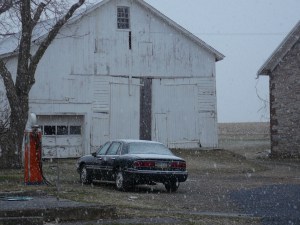
On a regular basis during my childhood a rather life-beaten large car would drive slowly up our farm lane and pull to a stop in the graveled parking area between the farm’s gas pump and the milking parlor.   The driver would step out and stand by his car patiently waiting (hoping?) to be greeted.  How Mr. Banks knew it was a good time to arrive, meaning that my father was close by, I can’t imagine.  My father would see the car drive up and head out the kitchen door to welcome him and chat as they stood by the car.

After a while, my father would come back in the house for the checkbook, write out a sum, and head back out to hand the donation to Mr. Banks.  This was not without some disgruntled murmuring from my mother and curious, suspicious stares from us children.  Who was this Mr. Banks anyway?  Did he really have a ministry with children on the streets of inner-city Harrisburg as he claimed?  Was he a legitimate church leader?  How in the world did he identify my father as a potential and consistent donor to his ministry?  How did he know it was safe to drive up our rural farm lane on a regular basis?  What did they talk about together, this older Black gentleman in a suit and tie and the rural, white Lebanon county farmer usually still dressed in his morning milking clothes?

In 2017 as I embarked on a Sankofa journey, a 3-day cross-racial prayer experience exploring the racial history of the US by traveling to sites of the civil rights struggle in the South, the opening session invited each pair of companions to share our first realization of race.  I was stumped for a while.  I don’t recall my answer but Iater realized upon reflection that my first experience of being aware of race was those visits by Mr. Banks.

Elder Matthew Banks was my introduction to persons of color, to the concept of inner-city ministry, and to creative risky, courageous donor development.  What I encountered of race I saw through the two very different lenses of my parents.  My mother had grown up in an all-white small rural community and had not ventured terribly far from home up to that point.  While she was fairly accepting of others, her frugal, thrifty PA Dutch formation pushed her to often frown at my father’s reckless generosity and Mr. Banks was no exception. 

My father, also raised in an all-white community, had his life altered when, at the onset of the Second World War, he declared himself a conscientious objector and served (as he often detailed) for 3 years, 9 months, and 21 days in Civilian Public Service.  This obligatory public service took him from rural Bedford County, PA all the way across the country to Santa Barbara, CA to the Los Prietos camp. There he shared in the leadership of a collection of dozens of men from all walks of life and varying attitudes toward their compulsory service.  My father’s world expanded greatly during those years.  Without that C.P.S. experience, being approached by Mr. Banks would have been a far greater stretch for my father for whom a gracious welcome somehow seemed natural to offer.  

I look back in utter shame and deep regret for my own mistrustful suspicions of Mr. Banks.  Why did I assume he was not a legitimate minister caring for his beloved community?  What caused me to see him as Other, as strange, as threatening?  Why did I not suggest that we welcome him into our home and offer warm hospitality as we did for other visitors?  Why did we not visit his church and community center in Harrisburg?  Why did my community and people generally regard Harrisburg’s inner city with fear, trepidation, and judgment? 

My own judgments of Elder Banks reveal an entrenched implicit racial bias that started at that young age and continues to this day.  Identifying, challenging, and dismantling white supremacy within me is an urgent work of the heart and soul.  My deep historic complicity with white supremacy is antithetical to the very gospel of Jesus Christ that I proclaim.   And yet it is unavoidable as it is `the air I breathe’.  While it is changeable, it is also surely a journey that will never end.

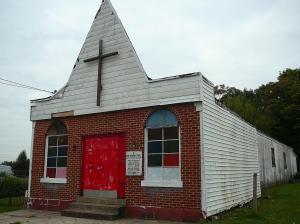
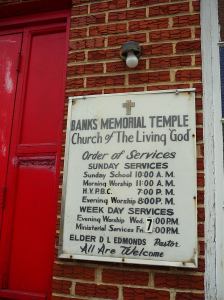
On a trip back home to Pennsylvania some years ago I decided to wander through neighborhoods of Harrisburg, enjoying memories of my 15 years residing there.  I realize now that I was also curious to know if I might find a community center with some relationship to the Mr. Banks of the distant past.   Driving down North Sixth Street I am embarrassed to admit my astonishment at finding the Banks Memorial Temple Church of the Living God.  My childhood suspicions and prejudices were thrust into the light of day as I parked in front of the building and saw the neat red brick-facade structure still standing.  

There was a Mr. Banks after all, and his precious ministry was visibly confirmed before my eyes.  He and his beloved wife, Mother Ida Banks, had founded the church and the ministry that still enlivens the surrounding neighborhood.  

Truly, “God surprises, and we have forgotten the surprise that is discipleship and the surprise we should be to the world as disciples.” (Jennings)

What things in your story are waiting to be told and heard?

Near the end of Luke’s gospel, two companions of Jesus ask him, “Are you the only stranger in [town] who does not know the things that have taken place there in these days?  Jesus asks, “What things?”

Of all the moments in the trial of Derek Chauvin, the one that must surely have caused some considerable frustration for the defense was the way that the testimony of Darnella Frazier backfired for the defense.  It’s been speculated that the defense hoped to discredit the testimony of this young woman whose videotape of the murder of George Floyd went viral after she posted it on Facebook.  Instead of showing her as only being interested in fame or notoriety and perhaps not being sincere, it was obvious to everyone that she was clearly dealing with the trauma of having witnessed his murder.  Now 18 years old she testified “that she has been haunted by what she saw, sometimes lying awake at night ‘apologizing to George Floyd for not doing more and not physically interacting and not saving his life.’”

A victim of secondary trauma, she talked about how every time she closes her eyes, “she sees George Floyd’s face as he’s dying. She opens them up and he’s gone, she closes them, and she sees him again.”  

Instead of serving the purposes of the defense team, she and other numerous witnesses are leading the nation through an essential step in responding to an event as horrible as George Floyd’s murder, that of telling the story, recalling the experience, giving voice to the trauma that lives within them and having it be heard.

I’ve been doing a lot of reading about trauma these last 5 months and I am learning about the effect of losses and tragedies, from small ones to enormous ones, and the effect that trauma has on the mind, the body, and the soul.  To be traumatized is to be harmed by some external force that threatens to destroy one. Of course, this can be not just physical, but the damage can occur to our psyches as well.  The harm done there is no less damaging than more visible wounds. “Like mortal wounds”, writes Judith Herman, “such harm to the psyche can destroy a human life, and precisely because it is invisible, it can do so in secret, hidden ways.” 

Five years ago in February of 2016, news shared with me by a close family member began to affect me in ways that I have just recently begun to explore.  For 4 and a half years I think I lived in the numbness and paralysis of denial that is common when trauma hits.  I didn’t speak of it much to anyone. It’s a self-protective measure many of us take because it’s just easier to keep on going and compartmentalize the pain that way. After all, one must function day to day.  And while I’ve come to regard this experience of mine as one of trauma, I readily acknowledge that my experience of trauma is infinitely less significant than those who suffer from real violence, abuse, and the unspeakable harms that frequent the news each and every day from around the globe.  

And yet, trauma is registered within us whenever and however it happens. No matter the type, trauma is experienced in the body and it also affects the soul and spirit profoundly in ways that shape our lives, our choices, our journey.  Post-traumatic stress disorder occurs to varying degrees in many persons, and I find myself being no exception there.

So, understandably I’ve been reading lots of books on trauma recently. I’ve read:  

  • The Body Keep the Score by Dr. Bessel Van der Kolk.  
  • My Grandmother’s Hands: Racialized Trauma and the Pathway to Mending our Hearts and Bodies by Resmaa Menakem. 
  • Next on my list is “Healing Racial Trauma” by Sheila Wise Rowe

This week I stumbled onto an interview by Krista Tippet on the podcast On Being with the Rev. Dr. Serene Jones, president of Union Theological Seminary in the City of New York.  A quote from this interview prompted me to read her book “Trauma and Grace: Theology in a Ruptured World” this past weekend.  And while it speaks to my personal journey and the work I’m undergoing; I believe it has a word to say to life together as a Church as a whole.  It’s a word I believe we need to hear but likely will find it hard to receive or ever put into practice. Most days I’m more pessimistic that I would like to be about the state of the various communities within Church life. Still, I can dream of another world where greater health would be possible.  Responding well to trauma requires us as a collective body to speak our hard truths to one another of pain and harm experienced, to listen receptively without judgment, and to do the courageous work of reimagining a different kind of future together.

In the podcast Dr. Jones comments: “…one of the things that I learned from life, but it came to the fore in writing the book on trauma, is that not just individuals but whole communities undergo trauma, and that one of the characteristics of trauma is the deep human desire to repress it and to not deal with the story of the harms that have happened. But the truth of the matter is, with individual and collective trauma, is that the harm haunts you — haunts your dreams as an individual, haunts your collective unconscious as a society — until you tell the story; till you face the truth of the horrors that have happened. And I think what is happening in our nation today is, all of the harms of the past have come up to claim us, all at once, and they’re not gonna let us go until we take the stride of reckoning with them.”

It’s worth thinking about the effect of trauma on the collective body of a whole community.  What does it do to a community when trauma and harm and pain are not acknowledged?  What are the ways that life together could be altered if trauma were addressed publicly instead of being ignored?  Will the public telling of stories of observers of George Floyd’s murder, for example, contribute to the healing of the community in Minneapolis, to the healing of our nation?  Will Darnella Frazier find a bit of healing at having told her story in the trial?

Dr. Serene Jones draws on the work of Judith Herman to suggest that healing from trauma can best take place in a process in which the traumatized person is able to testify of her or his experience to someone safe who is willing to receive that story.  The trauma survivor offers testimony to the harm endured and the receiver, the one who has established a place of safety for the telling of the story gives witness to the trauma, the agony, the pain, the previously unspeakable agony.

The hearing and receiving of the story mean that the voice of pain is heard, and that “the plight of the one suffering no longer needs to be hidden in a dark corner of the soul” but can be heard as lament and worthy of repair, writes Jones.

When this telling of the story occurs, then both the testifier and the receiver can together begin to “reimagine a future that allows the trauma, in the long run, to be integrated into a broader and more expansive story of hope and hence of future possibilities for fullness of life.” (Jones)

I found myself wondering what it would take for a reckoning to happen within the life of the particular church denomination in which I live and move, a reckoning of the harm done, the harm that we all have had a part in.  Some have caused harm by their own complicity.  I have caused harm by my own complicity.  Others have caused harm within the body by inflicting deliberate harm.  

Could there be a “Truth-telling and Listening” commission named?  A “testifying and receiving of stories” commission.  What would it be like to offer a place, a safe place, for stories of harm to be told and received? From persons of color.  From women harmed by the church. From members of the queer community and those whom they love.  For the work of trauma to begin there must be a safe space for these stories of trauma.  Would that begin to break us out of the paralysis we are in and free us to be courageous enough to invite storytelling to take place?  I believe that we need to pass through the stage of lament of what has been and to have that received and honored by others before we can re-imagine a future together.

I haven’t shared the content of my story here, for example, because I wonder if this is a safe place to do so, to tell and receive those stories that we each have within us.

I believe we could … but whether we will … remains to be seen.

Jesus, the Risen Christ, offered to Cleopas and his companion a chance to reckon with the trauma they had witnessed.  He simply asked, “what things have you witnessed?” and in the sharing of their story of trauma with Jesus, the safe and trustworthy listener, they discovered a future that they could never have imagined.  I believe that the Risen Christ has the power to create a hospitable space among us where the unspeakable stories of trauma can be spoken.  Where they can be believed and heard and embraced.  And where a future we cannot imagine now can open up among us. Oh, may that come to pass among us, that Jesus would be present that way as we are together. 

Loving God, for the courage of those who speak their truths, for the kindness of those who listen, and for the future we have not yet imagined but that You promise to create among us if we ask, we give You thanks. Amen

What story would you share as you walk on your path?

Letting Go of Strings…

“…if you cannot hear the sound of the genuine in you, you will all of your life spend your days on the ends of strings that somebody else pulls.”  

These words, written by Howard Thurman, stopped me in my tracks recently and were the catalyst for beginning to embrace daunting personal work that I now know is mine to do.  For the last five years I have put off this work, telling myself that the needs and interests of others close to me must be my priority.  I have few regrets for prioritizing, but urgent work now awaits ahead of me.

As I step into this journey, I am listening above all for the sound of the genuine within myself.  Thurman’s words arrest me.  They awaken within me a deep longing to find what is true for me out of my experience and the situation in which I currently find myself.  This is the work of personal discernment, that process upon which we embark when we have a passion to make sense of our lives and the ‘stuff’ that is part of our story.  Holy careful listening can help to discern the genuine from the noisy cacophony of voices clamoring for our attention.

But searching for the sound of the genuine…,whatever does that really mean?  In Thurman’s writings I have not found quick easy answers for this question.  This Black theologian and mystic from the 20th century with his characteristically slow, deep-voiced delivery invited his hearers and readers into a contemplative, reflective journey into the interior soul, a journey that could not be separated from the outward expression that engages the complex problems and oppressions of society.  Thurman’s profound calling of God beckons journeying courageously in both directions.

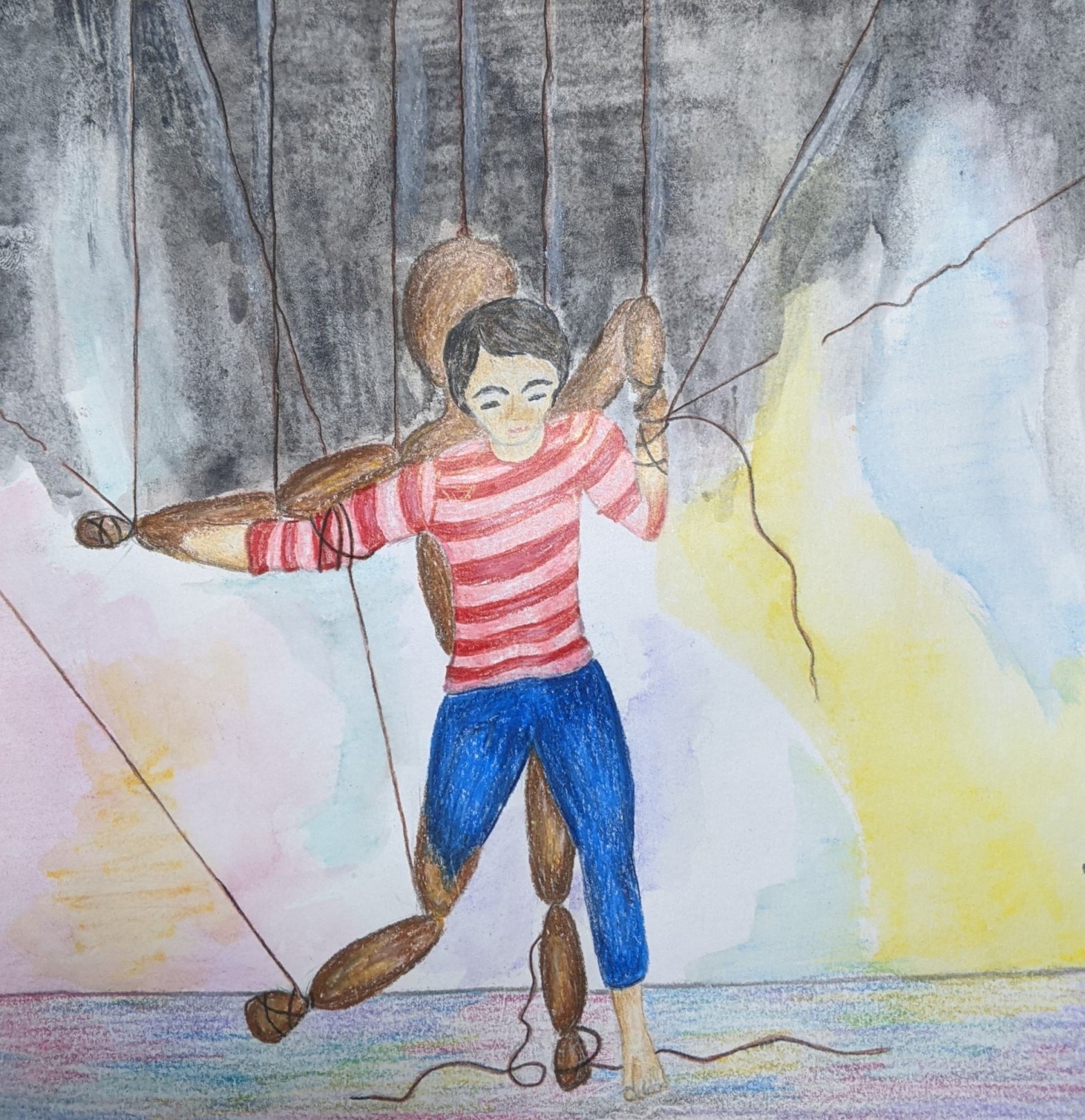
Thurman’s words nudge me to ask, “do I hear the sound of the genuine within me?  What is that genuine voice saying?”   And if I hear it and do not follow it, I am no better than a wooden marionette dangling from strings pulled by someone else.  In that haunting image I feel myself perpetually dangling from strings and agonizing, “am I powerless to break free?”  What would it mean to let go of those strings?  Who is pulling the strings from which I dangle?”  

Part of what is becoming genuine truth for me is the realization that in my life the Church has been pulling strings that dangle me at the ends of its theologies, some of which are frankly oppressive. In spite of all of the devastating beauty that keeps me tied to it, the Church also embodies, tolerates, and uses theologies that give power to patriarchy, homophobia, transphobia, xenophobia, and white supremacy, among others.  All these evils affect me in one way or another and have become internalized as a sense of my own superiority (racial, sexual orientation) or inferiority (gender).  By my active presence and leadership in a church that refuses to vigorously denounce and dismantle them, I am complicit.  I dangle and am pulled and twisted by these strings that connect me to the resultant oppression, fear, control, and shame around and within me.  And as I ignore the sound of the genuine within me, I surely become the puller of strings for others.

What will it feel like to let go of the strings?  To hear the sound of the genuine and follow it freely and joyfully? What does it look like for a human soul to fly free of the strings that cause dominating oppressive control? Is it possible to live a life of freedom by speaking and acting according to the genuine divine Spirit within?  To speak truth with courage and without fear of the reactions and actions of those threatened or offended by that truth?  To dream with moral imagination a new world into being?

As I break free, will I clatter to the floor like some collection of wooden pieces?  Or will God’s Spirit breathe powerful life into me as I rise to follow the sound of the genuine voice within?

Seeking to let go of the strings that tie me to what is not genuine and not liberating is my hope for this space.  I long to let go of what prevents me from hearing the sound of the genuine within me and speaking that truth. My hope is that it will be a space of mutual respect and hospitality for the truth that emerges when each of us hears the “sound of the genuine” and follows it. 

“Don’t ask what the world needs. Ask what makes you come alive, and go do it. Because what the world needs is people who have come alive.” (Howard Thurman)

 “Now the Lord is the Spirit, and where the Spirit of the Lord is, there is freedom.” (2 Corinthians 3:17)