“The Spirit presses us to join with people we do not want to join with or imagine intimate life. Yet it is life together in the Spirit of God as the goal that guides that thorny joining of peoples who never imagined themselves together. God surprises, and we have forgotten the surprise that is discipleship and the surprise we should be to the world as disciples.” (Willie James Jennings, Acts, Belief commentary, p. 255)
On a regular basis during my childhood a rather life-beaten large car would drive slowly up our farm lane and pull to a stop in the graveled parking area between the farm’s gas pump and the milking parlor. The driver would step out and stand by his car patiently waiting (hoping?) to be greeted. How Mr. Banks knew it was a good time to arrive, meaning that my father was close by, I can’t imagine. My father would see the car drive up and head out the kitchen door to welcome him and chat as they stood by the car.

After a while, my father would come back in the house for the checkbook, write out a sum, and head back out to hand the donation to Mr. Banks. This was not without some disgruntled murmuring from my mother and curious, suspicious stares from us children. Who was this Mr. Banks anyway? Did he really have a ministry with children on the streets of inner-city Harrisburg as he claimed? Was he a legitimate church leader? How in the world did he identify my father as a potential and consistent donor to his ministry? How did he know it was safe to drive up our rural farm lane on a regular basis? What did they talk about together, this older Black gentleman in a suit and tie and the rural, white Lebanon county farmer usually still dressed in his morning milking clothes?
In 2017 as I embarked on a Sankofa journey, a 3-day cross-racial prayer experience exploring the racial history of the US by traveling to sites of the civil rights struggle in the South, the opening session invited each pair of companions to share our first realization of race. I was stumped for a while. I don’t recall my answer but Iater realized upon reflection that my first experience of being aware of race was those visits by Mr. Banks.
Elder Matthew Banks was my introduction to persons of color, to the concept of inner-city ministry, and to creative risky, courageous donor development. What I encountered of race I saw through the two very different lenses of my parents. My mother had grown up in an all-white small rural community and had not ventured terribly far from home up to that point. While she was fairly accepting of others, her frugal, thrifty PA Dutch formation pushed her to often frown at my father’s reckless generosity and Mr. Banks was no exception.
My father, also raised in an all-white community, had his life altered when, at the onset of the Second World War, he declared himself a conscientious objector and served (as he often detailed) for 3 years, 9 months, and 21 days in Civilian Public Service. This obligatory public service took him from rural Bedford County, PA all the way across the country to Santa Barbara, CA to the Los Prietos camp. There he shared in the leadership of a collection of dozens of men from all walks of life and varying attitudes toward their compulsory service. My father’s world expanded greatly during those years. Without that C.P.S. experience, being approached by Mr. Banks would have been a far greater stretch for my father for whom a gracious welcome somehow seemed natural to offer.
I look back in utter shame and deep regret for my own mistrustful suspicions of Mr. Banks. Why did I assume he was not a legitimate minister caring for his beloved community? What caused me to see him as Other, as strange, as threatening? Why did I not suggest that we welcome him into our home and offer warm hospitality as we did for other visitors? Why did we not visit his church and community center in Harrisburg? Why did my community and people generally regard Harrisburg’s inner city with fear, trepidation, and judgment?
My own judgments of Elder Banks reveal an entrenched implicit racial bias that started at that young age and continues to this day. Identifying, challenging, and dismantling white supremacy within me is an urgent work of the heart and soul. My deep historic complicity with white supremacy is antithetical to the very gospel of Jesus Christ that I proclaim. And yet it is unavoidable as it is `the air I breathe’. While it is changeable, it is also surely a journey that will never end.
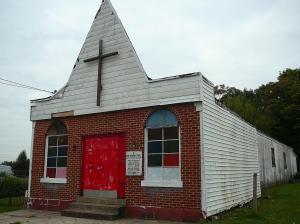
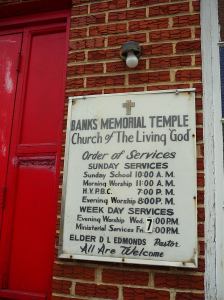
On a trip back home to Pennsylvania some years ago I decided to wander through neighborhoods of Harrisburg, enjoying memories of my 15 years residing there. I realize now that I was also curious to know if I might find a community center with some relationship to the Mr. Banks of the distant past. Driving down North Sixth Street I am embarrassed to admit my astonishment at finding the Banks Memorial Temple Church of the Living God. My childhood suspicions and prejudices were thrust into the light of day as I parked in front of the building and saw the neat red brick-facade structure still standing.
There was a Mr. Banks after all, and his precious ministry was visibly confirmed before my eyes. He and his beloved wife, Mother Ida Banks, had founded the church and the ministry that still enlivens the surrounding neighborhood.
Truly, “God surprises, and we have forgotten the surprise that is discipleship and the surprise we should be to the world as disciples.” (Jennings)
 Letting go of strings
I vaguely remember the details of this story. Was I around at that time or left for Juanita already? This whole story rings true to me — and thank you for telling it! The instinctive “trusting” nature of our Dad is/was pretty rare, I think.
LikeLike